

Beautiful Botswana Animals: Must-See Circle of Life in the Wild
For wildlife lovers such as myself, embarking on an African safari is the trip of a lifetime. One might even say “a top of the food chain” trip meaning top of the bucket list in travel talk. I know it was at the top of mine. In the summer of 2024, I got that life-changing chance. I’m breaking down all of the beautiful Botswana animals you must see in the wild. It truly was the “circle of life” experience and I want you to have the same!
This post contains affiliate links. At no additional cost to you, I may earn a small commission if you book or purchase through these links. You can read my full disclosure policy here.

Animals in Botswana
Botswana is one of the top countries for wildlife lovers. Botswana animals are prolific and there are many optimal locations for safe viewing in the wild.
But first…
About Botswana

With a population of approximately 2.6 million, Botswana is one of Africa’s safest, most peaceful countries. The country is roughly the size of Texas and has some of the best world-class safari experiences.
Fun facts about Botswana:
- It has the highest elephant population in the world (~130,000)
- Botswana is an upper-middle-income country (it produces diamonds-De Beers, anyone?)
- Botswana won its first Olympic medal (a silver) in London 2012
- The official language is English although Setswana is the most commonly spoken.
- Nearly 40% of Botswana’s land is protected.
- Botswana has the largest inland delta in the world, the Okavango Delta, which is also one of The Seven Natural Wonders of Africa as it is water within a desert!
- The Makgadikgadi Pan is one of the world’s largest salt flats (and special enough to be chosen as a location for a Taylor Swift video).
Where Is Botswana

Screenshot credit: Google Maps
Landlocked in southern Africa, Botswana is north of South Africa, east of Namibia, west of Zimbabwe, and south of Zambia. The border Zambia shares with Zimbabwe is home to the famous Victoria Falls!
Best Time to Visit Botswana
The best time to visit Botswana is May to October. Known as the dry season, this is also the best time to view wildlife. Within these months, the best are June to August as these are the coolest months (winter) making them most comfortable for Botswana safari rides.
Animals You’ll Most Likely See in Botswana
Most wildlife in Botswana are animals native to Africa. There are so many you will encounter that I can’t even mention them all. Keep reading to see the usual, expected list of lions, elephants, giraffes plus many others!
Is Botswana safe? Yes! In addition to its political, financial, and social stability, Botswana does not have much crime and is considered one of the safest countries in Africa.
Botswana Animals
What to Spot in Botswana

ALL. THE. ANIMALS. Keep your eyes open at all times. Seriously, I can’t tell you how many times I took a rest from holding my fantastic but heavy 600mm lens and camera body only to spot a rare animal in an unexpected location.
Animals in Botswana can appear when least expected so always be on guard with extra batteries and SD cards ready!
Let’s dive in!
The Big Five
How could I not start with the Big Five? If you aren’t familiar, the Big Five refers to the leopard, lion, elephant, Cape buffalo, and black rhino.
The name is thought to have originated with hunters who categorized them as the most difficult animals to hunt. Today, I’m happy to report it’s a much more common term among wildlife viewers. Thankfully!
Elephant

The African elephant is the largest and most prevalent animal in Botswana. With the world’s largest population, elephant numbers in Botswana reach over 130,000! Their average lifespan is 56 years and they can grow between 10 and 11 feet (3-3.3 meters) and weigh up to 13,000 lbs (5,896 kg).

We saw babies, gigantic males, trunk poses, and mud baths. We heard trumpeting. Truly magnificent experiences I can’t say enough about.

Rhino
The rhinoceros is the ONLY one of the Big Five we didn’t get to see. Due to high poaching rates, the government moved them to a protected sanctuary. Many sources online suggest rhinos were recently reintroduced to the Okavango Delta.
However, our guides at our private game reserve, the Okavango Delta, and Moremi Game Reserve all said the same thing. Not there. Moved for protection. So, sad they had to do this.
Leopard

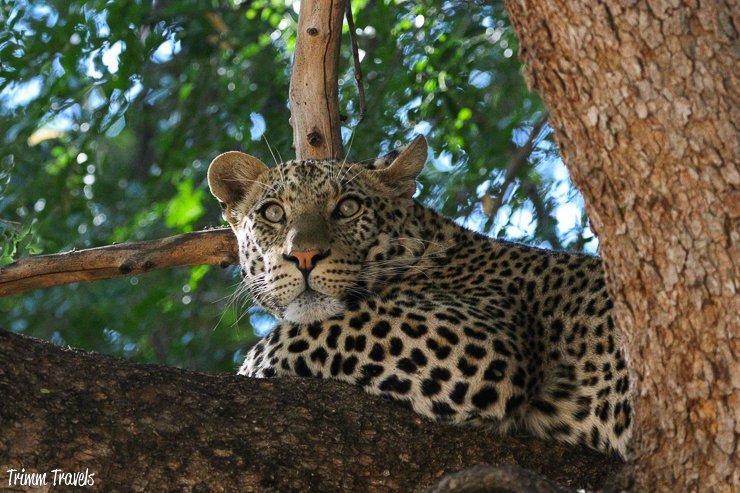
I hoped we would see a leopard but instead, we saw leopards, plural!
This is amazing considering how elusive the most common cat in Botswana is. Leopards outnumber lions by at least a couple thousand. However, a lion is much more likely to prey on a leopard.
Leopards love to drag their prey up into a tree to feast. Also, this protects its food source from other animals trying to steal it. We witnessed a kill hanging in a tree as well as the too-full leopard panting on the ground below.

Male leopard relaxing in a tree in Botswana
It took us a couple of days but we even saw a leopard in a tree. Even better, we saw a pair of leopards mating! These sightings are quite rare and there are just no words to describe this moment for me.

A pair of leopards mating in Botswana



Cape Buffalo

I didn’t see a Cape buffalo until the very last day. He saw us too. I was walking in the Okavango Delta when my guide quietly said, “Hold still.” Now, we weren’t in imminent danger. However, do NOT underestimate any of the animals of the Okavango Delta or any Botswana wild animals, period.
After seconds of holding still and being silent, the Cape buffalo returned to eating.
The males are larger than females and have “bosses” on their heads. This is where the horns meet on their heads. They must drink every day which is why they frequent the Delta.
TIP: When your guide instructs, obey right then. Ask questions later. It could be a life or death difference.
I know I’m missing one. The big one of the Big Five. I saved it for the next section!
Lion King Animals
Upon watching the movie…er…research, almost all of the animals in this Botswana animals post were in The Lion King. So, in this post, I will list the main characters as individuals or groups.
The lion headlines the Big Five and the stars of this iconic film.
Speaking of research, I did a LOT of it. Hey, do you know all of your hornbills, egrets, and antelopes? I didn’t either!
Lion, Lioness, Lion Cubs (Mufasa, Sarabi, Simba, Nala)

Fierce and fearless, the lion is at the top of the food chain. We saw a few Mufasas and several Sarabis, Simbas, and Nalas. Found all over Botswana including the central Kalahari, the African lion is social and lives in groups called prides.

The males are larger than females and have varying degrees of the famous mane encircling their faces. They are nocturnal, hunting at dusk and dawn. They can reach speeds of 45 mph and most often prey on zebras, wildebeest, and other medium-sized animals.

Lion feasting on a baby giraffe. Heartbreaking but it is the reality of the circle of life.
Interestingly enough, lions can have tendencies to go after certain animals. There is a pride in Botswana that focuses on hunting elephants and another that predominantly goes after hippos! 😳


Warthog (Pumbaa)

I can still hear our guides calling out, “Pumbaa!!” as they tried to get our attention. While neither rare nor uncommon, warthogs are very skittish. Act quickly before Pumbaa takes off!
Meerkat (Timon)
Hakuna Matata, y’all! Timon is a cute little guy. While the meerkat is common in Botswana, we didn’t find many and I wasn’t able to get photos. They are most often seen in the Kalahari Desert and the Makgadikgadi Salt Pans, neither of which was on our itinerary.
No, meerkats aren’t actual cats. They live in large groups and yes, can be found standing at attention together with their family members! They are expressive and vocal creatures that can reach speeds of up to 30 mph!
Red-Bill Hornbill (Zazu)

“But, Sire!” (pronounced si-uh) “Very well, Sire.” “Oh, Sire!” Can’t you hear him now? We saw a lot of Zazus. The red-billed hornbill is common in Botswana but birds are generally hard to capture on camera. Thankfully, over six days, I got plenty of opportunities to catch Zazu’s mug!
With a lifespan of up to 15 years, these birds spend most of their time on the ground or in trees. A fun fact about the red-bill hornbill is their first two vertebrae are fused to support their giant bills!
Baboon (Rafiki)
Setting the stage: Picture Rafiki holding up a tiny Simba at the very beginning of the movie.

Technically, Rafiki is a Mandrill even though he’s commonly called a baboon.
We saw baboons several times during our six safari days. They pull antics in the wild just as you would imagine. One of the highlights was seeing a baboon steal a kill from another one. There was running down from trees, squawking, hiding, and defending. Antics at their best!
Baboons live throughout several countries in Africa including Botswana. The most popular location to view them seems to be Chobe National Park; however, we saw them further south than that.
During their lifespan of 20-30 years, baboons feast on everything from seeds and plants to birds and smaller mammals. They fear falling prey to lions, hyenas, leopards, and crocodiles.
Spotted Hyena (Shenzi, Banzai, & Ed)


Proud hyena who just stole part of a lion’s kill
Yes. They do laugh. Yes. They are playful. Yes. They are sneaky. If you recall the spotted hyenas Shenzi, Banzai, and Ed from the film, they had distinctive personalities. I swear I saw all three of them in Botswana. Even good ol’ Ed, right, Ed? (yep, he’s nodding)!

Hyenas aren’t always easy to spot since they hide out waiting to scavenge. Look for them in the distance when lions are eating. That’s how we saw the first hyenas of the trip. Later on, we found a hyena den.

The cubs were SO cute and curious! They came up to the jeep with their little noses going full speed!

Fun facts about hyenas are they are led by alpha females (Shenzi), have high endurance, fear male lions, and are both hunters and scavengers.
Wildebeest (Stampede)

The blue wildebeest is native to Botswana.
We saw several wildebeest but thankfully, not in a stampede like the movie. Like the warthog, wildebeest are quite skittish. Catch them (on camera) while you can. Blink and they are taking off!
The wildebeest population has greatly decreased in the last couple of decades. With such unique looks, the wildebeest (Dutch for “wild beast”) is a herbivore, lives up to 20 years, and is the driver of migration.

Big Cats
While there are approximately ten kinds of African cats, most of them you won’t see. The main ones are the leopard, lion, (mentioned above in the Big Five and The Lion King, respectively), and the much rarer cheetah.
Cheetah

Botswana has the highest cheetah population in the world. Classified as “vulnerable”, cheetahs face a high risk of extinction in the wild (third only to endangered and critically endangered). They are a very rare sighting for safari adventurers.
However, we managed to see three! A mom, a brother, and a sister together. Cubs live with their moms until around 18 months old to hone their hunting skills.

Cheetah patiently waits as the impala detects its hunter’s presence
We spent at least 30 minutes watching the trio. Towards the end, the juvenile female sauntered off and began tracking an impala. For a few minutes, the impala was none the wiser. After awareness set in, the cheetah sat down to de-escalate the situation and a waiting game ensued.
While I imagine the winner of the patience game took the battle, we had to move on and didn’t witness it. But, try this on for size. The cheetah can go from stopped to speeds of 60 mph in only 3 seconds. While the apex predator is speedy, it is on the weaker side which is a primary reason for its vulnerability

Antelope Family
To put it lightly, the Antelope family is broad. Often confused with the deer family, members of the antelope family are what you will likely see most while in Botswana.
Impala

Arguably, the impala is the animal you will see most during game drives. Not kidding, we said, “Oh it’s just impalas” after only a couple of days. They are beautiful but quite plentiful and there is only so much time.
Impalas are part of the antelope family. The males have long spiral horns and scent glands on their foreheads which announce their presence to other males.
Kudu

Kudu is another member of the antelope family in Botswana. They have striking body features that look like white stripes. The males have beards and the largest horns of antelopes which can grow to 6 feet!
Highly alert and skittish, it takes a lot for the kudu to leave the safety of the brush for a drink at the watering hole.

Eland

The eland is plentiful in Botswana but fairly elusive. The largest antelope in Africa can weigh more than a ton and stand over 6 feet tall. We saw very few of these and they typically weren’t close but this lens solved that problem.
Bushbuck

The bushbuck is a small antelope standing around 2-2.5 feet tall. It looks like a baby deer but is a member of the antelope family. In addition to its size, other identifying features are white patches on its ears, neck, nose, chest, legs, and tail.
Waterbuck
The waterbuck is found primarily near the Okavango Delta and Chobe National Park. When threatened, they tend to head into the water to stop the chase from most predators.
Now, for the remaining animals that didn’t fall into one of the previously mentioned categories!
Botswana Land Animals
There are way too many animals to list in this category. So, these are the most common land mammals of Botswana I saw!
Giraffe

The very first Botswana wildlife animal I saw was the giraffe. These tall, graceful animals are majestic and elegant. Yes, I’m jealous. I wish I had eyelashes like that!
There are about 9,000 giraffes in Botswana. They live around 25 years in the wild and have a gestational period of 13-15 months usually producing one calf. On average, calves are 6 feet tall at birth. Let that sink in!

One of my fondest and saddest moments in Botswana involved a giraffe. The fondest moment was catching a mama giraffe approaching three calves and nuzzling just her baby who was in the middle.
The saddest moment was my second game drive where the male lion was feasting on a baby giraffe.

Back to happy. Have you ever seen or thought about how a giraffe drinks water? It’s super fascinating!

Zebra

A group of zebras is called a “dazzle”
I had magical feelings when I saw my first zebra in the wild. The national animal of Botswana is found throughout the country. During the rainy season, a dazzle of zebras will migrate to the salt pans.
Just like human fingerprints, no two zebras have identical stripes. Famous for its black and white stripes, some zebras have light brown stripes mixed in.
Additionally, we tracked wild dogs but never saw them. I saw mounds made by aardvarks but since they are nocturnal, that was another no-go. Other possible sightings we aren’t entirely sure about include mongoose, bat-eared fox, and the honey badger.
Botswana Water Animals
Botswana animals who love the water are most commonly found in the Okavango Delta and the Chobe River. I’ve already mentioned a few animals you will frequently find near or in the water. These are the buffalo and the waterbuck.
However, here are the main players you think of seeing on the reserve.
Hippo

I saw hippos on my very last day which was in the Delta. They were fascinating to watch. They swam, played, grunted, fought, and sunbathed. I enjoyed watching them from afar while cruising in my Mokoro!
A male can weigh up to 7,000 lbs (3,200 kg). No, that is NOT a typo. The largest hippo on record weighed in at 10,000 lbs! I had no idea they were THAT heavy!

Hippos may be visible fully on land, fully submersed in water, or you might only see eyes skimming along the surface. 👀 They are quite aggressive, mean animals so maintain distance. This is the time for a telephoto lens and binoculars.
TIP: Keep your eyes open and keenly aware when on or near the water. Stay FAR away and remember they can move quite quickly!
Nile Crocodile

Honestly, I had forgotten about the Nile crocodile so I wasn’t expecting to see one. However, I saw an albino on the private game reserve and many standard ones at Moremi Game Reserve.

Nile crocodiles have a lifespan of 40-60 years in the wild. Their typical diet is fish but they are opportunistic feeders and will attack animals (including small hippos!) that cross their path.
Birds of Botswana
No exaggeration (well, maybe a tiny bit), there are a gazillion types (over 600 species) of birds in Botswana. I decided a separate bird post might be warranted for later. For now, I highlighted my favorites below!
Lilac-Breasted Roller

Meet the Lilac-breasted Roller. I fell in love with this colorful beauty. Despite adequate numbers, we saw these only a handful of times in six days.
Lilac-breasted rollers have several colors and get their name from their aerial antics during the mating ritual. They swoop down dramatically while making loud sounds. I was just happy to catch it on camera at all. This bird doesn’t stay still long!
Stork

There are a few different types of storks in Botswana. Most colorful, the saddle-billed stork, was my favorite!

We also saw the super interesting black stork with its orange legs and bill!
White-Fronted Bee-Eater

There are different kinds of bee-eaters but this one is the White-fronted bee-eater. These pretty birds dig holes in cliffs or banks and nest inside them. They will fly out in droves and fly right back into the nest. As you might have guessed, their diet consists mainly of bees!
Gray Go-Away-Bird

“Go away…go away!” That is what the gray go-away-bird (a turaco) sounds like and how it got its name. Seemingly, anytime another animal or even humans are in its vicinity, the go-away-bird starts squawking and sounds like someone saying “Go away, go away!”
And More
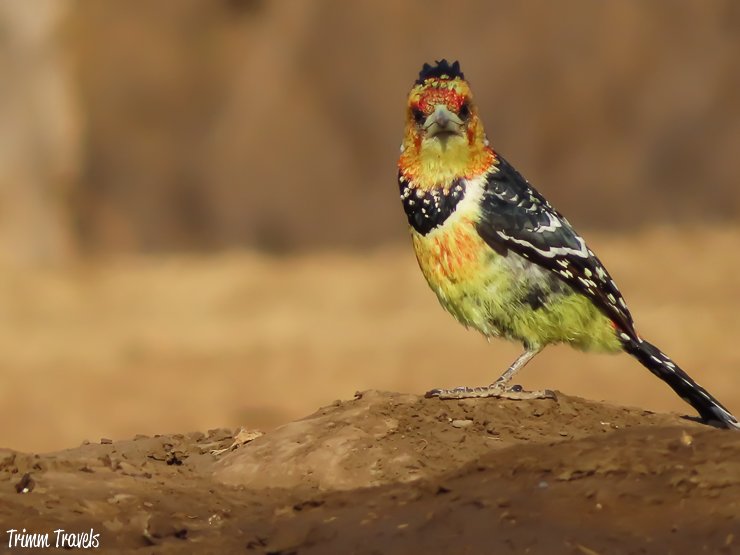
A crested barbet at a watering hole in Botswana
The list goes on of countless colorful birds and even ostriches. I recommend capturing them in the moment and research the identity later!
TIP: Watering holes are a top place to see many different bird species.
BOTSWANA RESOURCES & RECOMMENDATIONS
BOOK FLIGHTS
Use Kayak to search for flights and compare prices from 100s of sites. Save your plans, price freeze options, and flight trackers are just a few perks I love!
BOOK HOTELS
Use Booking.com or Hotels.com to find the best hotel for you at the best price. You can even find guest houses and bed and breakfasts. Here are links for specific Botswana locations: Okavango Delta, Maun, Chobe National Park, Moremi Game Reserve, Kasane.
COMPARE HOTEL REVIEWS
Use TripAdvisor to compare hotel reviews by other travelers.
BOOK TOURS
Use GetYourGuide to book tours. I booked all of my Botswana tours with them!
TRAVEL INSURANCE IS A MUST
Please don’t forget travel insurance! Thankfully, I’ve never had to make a claim but you won’t know until it’s too late, so be prepared.
- World Nomads (for the international adventure traveler)
- Travelex (for US domestic and international plans)
- MedJet (global medical evacuation and medical coverage)
- GeoBlue* (great for annual plans)
*Requires a US domestic health insurance plan
ALL OTHER TRAVEL RECS
See my resources page for all the other brands I use and recommend, including gear, tech, VPNs, car rental companies, train travel, and more!
PIN IT!


Sundowners at the watering hole. Cheers to Botswana animals!
See why I love Botswana safaris so much? They are absolutely worth the time and money it takes to travel for the beautiful Botswana wildlife.
Have you seen any of these wild animals in Botswana? What about any other kinds of animals in Africa that might be in Botswana? Have you been on any safaris in this country? I would love to hear about your experience which we all can learn from!
‘Til next time…
Trimm Travels,
Heather
Similar Posts
Unique Things to Do in Kyoto Japan + A Michelin Kyoto Experience
A trip to Japan must include the cool and unique things to do in Kyoto. And, your visit isn’t complete without a Michelin Kyoto experience!
Where To Stay and Eat in Geneva, Switzerland
I was highly excited about eating my way through Switzerland and Geneva proved itself to be quite tasty and delightful. With fabulous eats and an amazing hotel experience, check out the best places to eat and the best place to stay in Geneva, Switzerland!
Touring AT&T Stadium + Where to Eat Lunch in Arlington, Texas
Spend the day in Arlington touring the world’s largest domed structure, AT&T Stadium! Then head to this restaurant featured on Diners, Drive-Ins and Dives for lunch!
One Day in Casablanca, Morocco: Hotel, Highlights & Historical Eats
Are you thinking about visiting Casablanca but don’t have much time and aren’t sure what to do? That’s okay because one day in Casablanca is all you need! I’ve got the highlights, the hotel to stay in and that historical restaurant all right here in one easy-to-access place!
Mall of America Attractions: The Highlights + Where to Stay
If you’re heading to Minneapolis but don’t have a lot of time to explore America’s largest mall, then my guide to the Mall of America attractions will help you navigate the highlights in only one day! Find out where to eat, where to stay and what to do all right here!
Clarksville Tennessee Restaurants You Must Try
Clarksville Tennessee restaurants have it going on. From unique Southern eats to cocktails with glitter, it’s a foodie scene that should be on your radar with some of the best food you will ever put in your mouth. Plan your own personal food tour with these menu recommendations!


I leave for Africa six weeks from tomorrow. Botswana is on my itinerary, so this is perfect timing for this post.
Hi Amy-Yay!! You will love Botswana! So excited for you and I’m glad my post is perfect timing for you. I can’t wait to hear about your trip when you get back. Have the best time every and thanks for reading! 🙂
I’m just going to say it — I am so envious. Definitely a bucket list item for me. Maybe some day. Thank you for the pictures. Hopefully awareness of some of these endangered species will provide the impetus for saving them for generations to come.
Hi Lance-Yes! That is what I’m hoping. These beautiful animals are captivating and the only way they should be shot is with a camera. I highly recommend adding it to your list if at all possible. It’s not an easy trip to get there or finance but it’s so highly worth it! Thanks for reading! 🙂
Your photography Is spectacular! How do you do the closeups? Do you use telephoto lenses? The only time I got this close to wildlife was at a beach resort in Bali. I arose at dawn, and went outside to take photos of the sunrise, which was stunning. Much to my amazement, I saw a family of monkeys perched on a ledge, watching the sunrise! I couldn’t believe it. It reminded me of a Disney cartoon, so I enjoyed your Lion King references! I mentioned it to the swimming pool attendant, and he said they did that every morning (there were quite a few of them in addition to the family watching the sunrise). He said the monkeys came out each morning scavenging food that hotel guests left on their balconies, disappearing into the jungle before most of the guests woke up.
Hi Michael-Thank you so much!! Yes, I used a telephoto lens. The main one I used on this trip was a 600mm. That said, our guides got us as close as we could safely get without disturbing the animals or putting us in danger. At one point, one of the leopards came right by our jeep and laid down (like a domestic cat would next to its owner). The guide was like nope. I know she approached us but not safe and they turned on the jeep and we backed up and got a safe distance away. Didn’t bother the leopard at all! And the monkeys are cool! Yes, they are little scavengers and thieves. LOL! We stayed in a camp with glamping tents and our shower was outdoors and we had a box to put our stuff in that said “monkey no see, monkey no take”. LOL! I will be writing on that whole experience soon, hopefully. Thanks for reading! 🙂
I haven’t been on a safari yet, but it seems yours was truly an incredible adventure. You’ve taken maaaany photos of the wildlife, and they all seem made from great proximity. Thanks for sharing your amazing journey!
Hi Ivan-It was truly an amazing experience. Definitely one of my top trips ever! The proximity was pretty great for wildlife (but a safe distance always as our guides determined that). But I had a 600mm telephoto lens as well. Otherwise, I wouldn’t have gotten the photos I did! Thanks for reading! 🙂
Excellent post. Botswana sounds amazing, and my bucket list just got bigger. For some reason, I think I would be most excited about seeing wild hippos up close. Your photos were great by the way.
Hi Alan-Thank you! I really appreciate that! Yes, definitely put it on your bucket list. I can’t highly recommend it enough or say enough great things about it. The wild hippos were pretty cool. We couldn’t get as close to the as we could some of the other animals just because they are notoriously mean and aggressive and swim much faster than one realizes. Those photos I shot with a 200mm lens. Thanks for reading! 🙂
Loved reading your post! I have not been to Africa yet, but now Botswana is in my bucket list. Your images are awesome – that closeup of the elephant and giraffe in particular. You got to see so many animals! Looks like a great adventure!;-)
Hi Jan-Oh, I’m so glad you want to go to Botswana now. The animals are beautiful and the people are THE best!! They are the nicest, friendliest, people! Also, thank you for the compliment on my photography. That means SO much to me. I did have a telephoto lens with me and was in my element with wildlife photography! Thanks for reading! 🙂
I’m in love with Africa. I experienced amazing safari in Kenya.
When we were in Victoria Falls, we wanted to go to Botswana too, but didnt manage. Hopefully next time.
You made very beautiful pictures ♥️
Hi Nat-Thank you so much, I truly appreciate that and it means a lot. I loved Botswana. And we are the reverse, I didn’t make it to Victoria Falls but hopefully next time! Thanks for reading! 🙂